“Laser dentistry” turns up often in dental marketing, usually attached to words like gentle, modern, or drill-free. If you have seen the phrase on a practice website and wondered what it actually involves, the short answer is that it is not a single procedure. It is a category of tools.
A dental laser is an instrument, and like any instrument, it is well suited to some jobs and not others. Knowing where lasers fit, and where they do not, makes it easier to read past the marketing and understand what to expect.
What is Laser Dentistry?
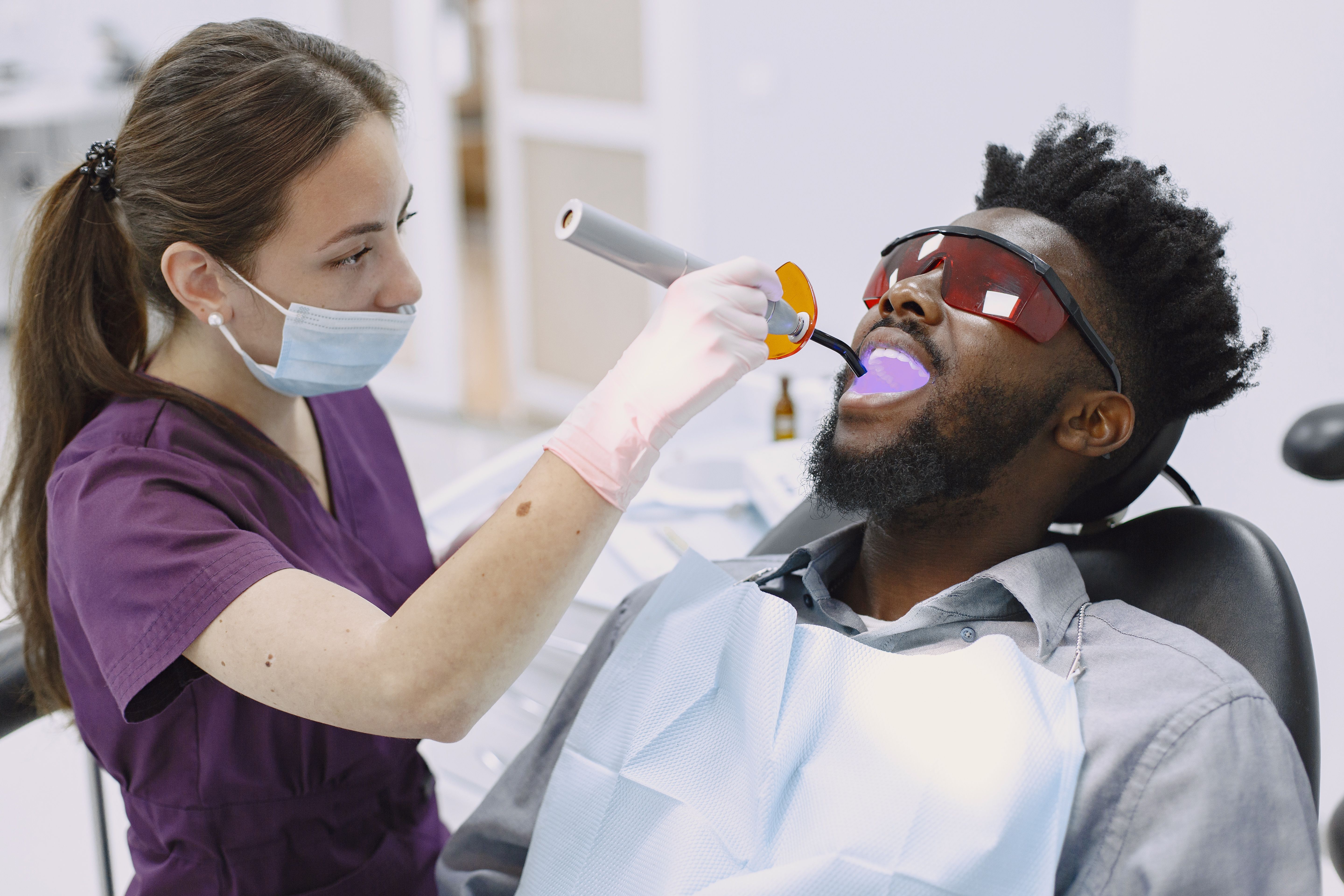
Laser dentistry is a treatment that uses focused light energy to perform various procedures on teeth and gums. The dental laser sends out a narrow beam of light. The tissue the dentist focuses the laser on absorbs light and turns it into heat, and the heat is what does the work.
Not all lasers are the same. Each one gives off a different wavelength of light, and different wavelengths of light are absorbed by different things in the mouth. That is why no single laser can do every job.
Most dental lasers fall into two groups. Soft tissue lasers, such as diode and carbon dioxide (CO2) lasers, use wavelengths of light that are absorbed by water and color in the gums. Dentists use them to cut, shape, or disinfect soft tissue. Hard tissue lasers, mainly erbium lasers (Er:YAG and Er,Cr:YSGG), are absorbed by water and by the minerals in tooth enamel, so they work on teeth and bone.
The different types of laser dentistry open doors to treating a range of problems with light energy. It works well for certain procedures, but it does not always replace the regular tools a dentist already uses.
When Do Dentists Use Laser Dental Procedures?
Dental lasers are most often used on soft tissue, which includes the gums and other soft parts of the mouth. The beam seals small blood vessels as it works, so these treatments often cause less bleeding. In many cases they also need fewer stitches and less numbing than a scalpel would. Lasers can work on teeth too, though for a smaller set of jobs.
Here is where dentists use lasers:
- Reshaping the gum line. Lasers can trim or reshape gum tissue. This is done to remove extra or overgrown gum tissue.
- Releasing a tongue or lip tie (a frenectomy). Lasers can free up a tight band of tissue that limits movement in the mouth.
- Taking a tissue sample. A dentist can use a laser to collect a small sample of tissue for a biopsy.
- Treating gum disease. Lasers are used inside deep gum pockets to lower the amount of bacteria as an added step during a deep cleaning.
- Removing early decay. Some erbium lasers can clear out early decay and get a tooth ready for a filling without a regular drill, which means less noise and vibration for the patient.
- Finding cavities. Diode lasers can spot tooth decay at an early stage.
- Treating sensitive teeth. Lasers can seal the tiny openings at a tooth’s root that lead to sensitivity.
- Whitening teeth. Some whitening treatments use a laser to speed up the process during an office visit.
These are all real, proven uses, but whether a laser is used will depend on the situation. And while ads for laser dentistry might confuse people into thinking it is one all-purpose treatment, there are different lasers for different treatments.
When Are Dental Lasers Not Helpful?
Lasers are not the right choice for every case, and a careful dentist will say so. Lasers usually cannot be used on teeth that already have work done, like fillings or crowns. They also are not a good fit for taking out old metal fillings, shaping crowns, or many of the bigger repair jobs that traditional tools handle quickly and reliably. Standard drills and hand tools are often faster, work in a wider range of situations, and cost a lot less to use. That is why they are still the go-to for most everyday dentistry.
Why Not All Dentists Use Lasers
Lasers are becoming more common in dental offices, but they are not available everywhere. In one 2022 survey, about 45% of dentists said they used a laser, up from 36% the year before.
Dental lasers are cleared by the FDA for certain uses and are regulated as medical devices. But being cleared is not the same as proof that a laser works better than the other options for a given job. Using one safely also takes special training. Many states require dentists to complete documented laser training before they can use certain devices, and the American Academy of Pediatric Dentistry also calls lasers a complement to standard tools and recommends that dentists get extra training before using them. The equipment is also expensive, and may not be worth the investment for some dental offices.
Between the cost, the training, and the fact that lasers help with only some of the procedures a regular practice handles, many skilled dentists use them for select cases, or not at all.
Laser Dentistry, in Focus
Laser dentistry is not the best solution for every problem, but it works well for the jobs it’s suited to, especially soft tissue work like reshaping gums or treating gum disease. It’s a proven part of modern dental care that can make those procedures more comfortable and more precise. A good dentist picks the tool that fits the procedure, whether that’s a laser or a traditional drill, based on what gives the patient the best result.
Ready to find a dentist near you? Use our online directory to connect with a practice and ask which tools they use and why.